Grinding Media for Gold & Silver Mines: High-Chrome Solutions for Quartz Abrasion & Leaching Efficiency

Gold and silver processing operations present unique grinding challenges distinct from base metals. Because precious metals are frequently finely disseminated within ultra-hard quartz matrices, grinding circuits must achieve high liberation fineness while keeping operating expenses in check. Furthermore, downstream chemical extraction processes (such as cyanidation and acid leaching) are exceptionally sensitive to pulp chemistry.
Selecting grinding media for precious metal circuits is not just about resisting mechanical wear—it is directly tied to maximizing gold/silver metallurgical recovery and reducing leaching reagent consumption. Matching media alloy chemistry against quartz-rich ore mineralogy is essential for optimizing plant profitability.
1. Key Gold & Silver Ore Characteristics & Media Selection Logic
A. Quartz-Dominant Gangue Mineralogy (Extreme Quartz Abrasion)
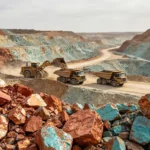
- Ore Property: Gold and silver ores are commonly hosted in hard quartz veins, pyritic matrices, or silicate rocks. The Bond Work Index (BWi) frequently ranges from 16 to 22 kWh/t, and quartz content (SiO₂) often exceeds 70%–85%.
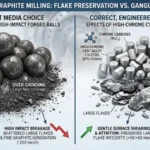
- Selection Logic: Standard forged carbon steel balls suffer catastrophic wear rates when processing high-quartz ores, leading to prohibitive media consumption costs (g/ton).
- Engineered Match: High-Chrome Cast Balls (Cr 12%–22%). High-chromium carbides (M₇C₃ type) embedded within a martensitic matrix deliver supreme micro-hardness (62–67 HRC), offering extraordinary resistance to high-stress quartz scratching and abrasion.
B. Tramp Iron Interference in Leaching Circuits (Reagent Poisoning)
- Ore Property: Downstream gold and silver recovery relies on cyanidation, thiosulfate, or acid leaching. Free tramp iron (Fe⁰) generated by grinding ball wear consumes critical dissolved oxygen (DO) and active cyanide ions (CN⁻) to form ferrocyanide complexes.
- Selection Logic: High media wear directly poisons the pulp chemistry, driving up cyanide and oxygen addition costs while depressing gold/silver dissolution rates.
- Engineered Match: High-Passivation High-Chrome Alloys (Cr 18%–26%). Ultra-low dissolution rate high-chrome balls prevent free iron release into the pulp, keeping dissolved oxygen levels stable and reducing cyanide consumption by up to 15%–30%.
C. Fine Dissemination & High Liberation Sizing (Slurry Attrition)
- Ore Property: Precious metals often occur as sub-micron or microscopic particles trapped inside sulfide lattices or quartz grains, requiring fine grind targets (typically P₈₀ = 38–75 μm, or ultra-fine regrind P₈₀ < 20 μm).
- Selection Logic: Secondary and regrind chambers require maximum surface area contact to perform efficient attritional grinding without over-grinding or crushing media into spalls.
- Engineered Match: High-Chrome Micro Balls & Steel Cylpebs (Ø15mm–Ø30mm). Replacing spheres with Cylpebs in fine grinding provides line-to-line surface contact, optimizing fine particle reduction and improving energy efficiency.
2. Media Selection Matrix Tailored to Gold & Silver Circuits
| Grinding Circuit | Gold / Silver Ore Characteristic Challenge | Primary Selection Metric | Recommended Media Type | Alloy & Hardness Profile |
|---|---|---|---|---|
| Primary SAG / Ball Mill | High quartz impact, large ROM feed chunks | High Impact Toughness + Moderate Hardness | High-Toughness Forged Alloy Steel Balls (Ø90–Ø125mm) | High-Carbon Cr-Mo Forged Alloy (56–60 HRC) |
| Secondary Ball Mill | Severe quartz abrasion (SiO₂ > 70%), high wear rates | Ultra-High Abrasion Resistance | High-Chrome Cast Balls (Ø30–Ø60mm) | Cr 12%–18% High Chrome Alloy (62–66 HRC) |
| Leach Feed Fine Milling | Reagent consumption risk, high fineness target | Low Tramp Iron Release + Surface Area | High-Chrome Cast Micro Balls (Ø15–Ø25mm) | Cr 18%–22% High Chrome Alloy (64–67 HRC) |
| Regrind / Tower Mills | Micro-fine liberation (P∯₀ < 25 μm), high energy draw | Attritional Surface Contact, Corrosion Protection | High-Chrome Cylpebs or Micro Balls (Ø10–Ø20mm) | Cr 20%–26% Ultra-High Chrome Alloy (65–68 HRC) |
3. Measurable Financial & Metallurgical Impact
- 50%–65% Wear Rate Reduction: Replacing low-alloy balls with high-chrome alloys in quartz-rich gold circuits dramatically slashes consumption (g/ton).
- 15%–30% Cyanide Reagent Savings: Preventing metallic iron (Fe⁰) contamination eliminates cyanide-consuming ferrocyanide reactions, directly reducing OpEx in CIL/CIP circuits.
- 0.8%–1.5% Higher Gold/Silver Recovery: Higher pulp dissolved oxygen levels accelerate leaching kinetics, ensuring complete precious metal dissolution.
- Zero Diaphragm Screen Blinding: Refined carbide microstructures guarantee structural integrity with breakage rates below 0.03%.
4. Operational Case Study: 12,000 TPD Quartz-Vein Gold Mine
Ore Profile: A high-grade quartz-vein gold operation in South America (SiO₂ content > 78%, BWi = 18.5 kWh/t) utilizing a primary ball mill followed by Carbon-in-Leach (CIL).
The Problem: The plant was using standard low-chrome forged balls. Quartz abrasion caused extreme media wear (850 g/ton). Furthermore, free iron dissolved in the pulp consumed excessive sodium cyanide (NaCN) and depleted slurry oxygen, suppressing gold leach recovery.
The Tailored Solution: Transitioned secondary grinding to Cr 18% High-Chrome Cast Balls (Ø40mm / Ø50mm blend) with optimized carbide heat treatment.
The Results:
- Specific grinding media consumption dropped by 58% (from 850 g/ton down to 357 g/ton).
- Sodium Cyanide (NaCN) consumption in the CIL circuit decreased by 22% due to reduced tramp iron contamination.
- Pulp oxygen levels stabilized, yielding a 0.85% boost in overall gold leach recovery.
Message us for more information