Grinding Media for Lithium & Industrial Minerals: Ultra-High Chrome Solutions Against Iron Contamination

In the lithium-ion battery supply chain (spodumene and lepidolite processing) as well as the deep processing of high-purity industrial minerals (such as high-purity quartz, feldspar, and photovoltaic glass raw materials), grinding operations face a distinct set of operational challenges. Beyond the high hardness and extreme abrasiveness of these minerals, downstream applications enforce exceptionally strict limits on iron impurity content (Fe%).
Selecting grinding media for lithium and high-purity industrial minerals requires resolving the fundamental tension between high-stress quartz/silicate abrasion and mandatory iron contamination prevention. Precisely matching the metallurgical microstructure of the grinding media against non-contamination requirements is key to securing battery-grade lithium concentrate purity, high-purity mineral whiteness, and significantly lower operational expenditures (OpEx).
1. Key Lithium & Industrial Mineral Characteristics & Media Selection Logic
A. Exceptionally Strict Iron Contamination Limits (Preventing Product Toxicity & Discoloration)
- Mineral Property: Battery-grade lithium carbonate and lithium hydroxide require extremely low, ppm-level iron tolerances. Similarly, high-purity quartz and feldspar used in solar glass or high-end ceramics experience darkening or yellowing after high-temperature firing if trace iron is present.
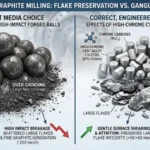
- Selection Logic: Standard forged steel or low-chrome balls release large amounts of free metallic iron (Fe⁰) into the slurry through severe spalling and wear, which directly degrades raw materials or increases expensive magnetic separation costs.
- Engineered Match: Ultra-High Chrome Cast Alloy Balls (Cr 20%–28%). High chromium content forms a dense, stably passivated protective oxide layer on the alloy surface, reducing metallic spalling and chemical dissolution to negligible levels and cutting off iron contamination at the source.
B. Extreme Hardness of Spodumene and Quartz (High-Stress Micro-Abrasion)
- Mineral Property: Spodumene possesses a Mohs hardness of 6.5–7.0, while high-purity quartz reaches 7.0, driving Bond Ball Mill Work Index (BWi) values up to 16–22 kWh/t.
- Selection Logic: Low-grade grinding media wear down rapidly under these abrasive conditions (often exceeding 1,000 g/ton) while suffering severe deformation and ball breakage.
- Engineered Match: Ultra-High Hardness Martensitic High-Chrome Micro Balls (63–67 HRC). Engineered via tailored heat treatment to convert the matrix into fine martensite with dense M₇C₃-type chromium carbide precipitates (microhardness up to 1,200–1,800 HV), these balls strongly resist scratching and micro-cutting from hard minerals.
C. Slurry Potential Sensitivity in Flotation and Acid Leaching
- Mineral Property: Spodumene flotation (using fatty acid collectors) and subsequent acid roasting/leaching processes demand extreme electrochemical purity within the slurry.
- Selection Logic: Dissolved iron species from low-alloy media indiscriminately adhere to both spodumene and gangue surfaces, destroying collector selectivity and lowering lithium concentrate (Li₂O) grade.
- Engineered Match: Corrosion-Resistant Ultra-High Chrome Micro Balls & Cylpebs (Ø15mm–Ø30mm). Exceptionally low wear maintains the natural electrochemical slurry environment, ensuring precise collector absorption and boosting lithium recovery.
2. Media Selection Matrix Tailored to Low-Iron & High-Hardness Ore Circuits
| Grinding Circuit | Lithium / Industrial Mineral Challenge | Primary Selection Metric | Recommended Media Type | Alloy & Hardness Profile |
|---|---|---|---|---|
| Primary Mill | Large ROM feed size, high hardness impact | Impact Resistance + Ultra-Low Wear | Special High-Toughness Cast Balls (Ø60–Ø90mm) | Cr 15%–18% High Chrome Alloy (60–64 HRC) |
| Secondary Mill | Severe quartz/spodumene abrasion, strict zero-iron tolerance | Iron Contamination Prevention + High Hardness | Ultra-High Chrome Wear-Resistant Balls (Ø25–Ø50mm) | Cr 20%–26% Ultra-High Chrome (63–67 HRC) |
| Fine Regrind | Ultra-fine liberation passing 325 mesh, high product purity | Low Dissolution Rate + High Contact Surface Area | Passivated Ultra-High Chrome Micro Balls / Cylpebs (Ø10–Ø20mm) | Cr 22%–28% Passivated Ultra-High Chrome (64–68 HRC) |
3. Measurable Financial & Quality Benefits
- 70%–85% Reduction in Iron Contamination: Passivated surfaces on ultra-high chrome alloy balls dramatically reduce free iron spalling, relieving downstream magnetic separation load.
- 50%–65% Lower Specific Wear Rate: High-density chromium carbide precipitates effectively resist cutting wear from spodumene and quartz, outperforming standard forged balls.
- 0.3–0.8 Percentage Point Increase in Li₂O Grade: Eliminating free iron interference improves flotation selectivity between spodumene and feldspar gangue.
- Elimination of Frequent Topping-Up Shutdowns: High sphericity retention and zero breakage rates ensure continuous, stable mill operation.
4. Operational Case Study: 1,500,000 TPA Spodumene Beneficiation Plant
Ore Profile: A major Australian spodumene mining operation (Li₂O head grade 1.3%, gangue composed mainly of quartz and feldspar, Mohs hardness 7.0) aimed to produce battery-grade lithium concentrate (Li₂O ≥ 6.0%) with stringent iron restrictions.
The Problem: The plant originally used standard low-chrome forged balls in its secondary mills. Severe abrasion from spodumene resulted in high media wear (920 g/ton). Furthermore, iron debris contaminated the slurry, raising iron levels in the lithium concentrate above export limits, overloading magnetic separators, and reducing lithium recovery.
The Tailored Solution: Replaced the media in secondary grinding and fine regrind circuits with specialized Cr 24% Ultra-High Chrome Cast Micro Balls (Ø25mm / Ø35mm ratio).
The Results:
- Media consumption dropped by 63% (from 920 g/ton down to 340 g/ton).
- Media-induced iron contamination in the slurry dropped by 78%, bringing lithium concentrate quality well within battery-grade export specifications.
- Improved flotation kinetics increased Li₂O recovery by 1.1%, while power and maintenance costs for magnetic separation decreased substantially.
Message us for more information