Grinding Media Selection for Iron Ore Mines: High-Density & Fine-Grinding Solutions

Iron ore processing (handling magnetite, hematite, and taconite deposits) presents distinct mechanical challenges due to heavy slurry densities, aggressive mineral impact, and strict particle liberation requirements. Because high iron recovery relies on separating iron oxides from siliceous gangue prior to magnetic separation or flotation, grinding circuits must achieve high particle fineness without excessive media wear or severe energy losses.
Selecting grinding media for iron ore circuits requires balancing high volumetric impact resistance, heavy-slurry abrasion protection, and fine-grinding contact kinetics. Matching media metallurgy against iron ore mineralogy is essential for maximizing concentrate grade, throughput, and energy efficiency.
1. Key Iron Ore Characteristics & Media Selection Logic
A. Heavy Slurry Density & Massive Ore Specific Gravity (High Energy Impact)
- Ore Property: Iron ores possess a significantly higher specific gravity (SG = 4.2–5.1) compared to base metal ores. High slurry density creates elevated mechanical drag, high dynamic wear rates, and intense impact forces inside primary ball mills.
- Selection Logic: Media must feature high volumetric hardness and strong structural integrity to resist spalling and spalls under heavy-density slurry impact.
- Engineered Match: Heavy-Duty High-Chrome Cast / Forged Balls (Ø60mm–Ø100mm). Engineered with deep-hardening Cr-Mo alloys, these balls maintain uniform volumetric hardness (58–63 HRC) from surface to core, ensuring zero deformation in dense iron ore slurries.
B. High Fineness Liberation Targets for Magnetic Separation (Slurry Attrition)
- Ore Property: Magnetite and hematite grains are frequently tightly intergrown with silica. Achieving target concentrate grades (Fe > 65%–68%) requires fine grinding to pass 200 mesh (P₈₀ = 45–75 μm, or finer for reverse flotation).
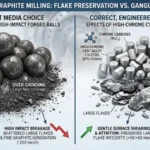
- Selection Logic: Secondary and tertiary fine-grinding stages require maximum surface area contact to accelerate particle reduction without generating unneeded over-grinding or slimes.
- Engineered Match: High-Chrome Micro Balls & Steel Cylpebs (Ø15mm–Ø30mm / Cylpebs). Cylpebs provide line-to-surface grinding contact rather than point-to-point sphere contact, increasing active grinding contact area by 15% and boosting discharge fineness.
C. Micro-Slurry Abrasion & Liner / Media Passivation
- Ore Property: Iron ore concentrates, especially fine magnetite slurries, act as dense liquid abrasives that rapidly scour metal surfaces in high-speed secondary mills.
- Selection Logic: Low-alloy carbon balls wear down rapidly into non-spherical shapes, causing mill charge slip, reduced grinding efficiency, and frequent topping-up shutdowns.
- Engineered Match: Medium/High-Chrome Cast Balls (Cr 10%–16%). High-chromium carbide microstructures maintain ball sphericity over long operational cycles, drastically reducing specific consumption (g/ton).
2. Media Selection Matrix Tailored to Iron Ore Circuits
| Grinding Circuit | Iron Ore Characteristic Challenge | Primary Selection Metric | Recommended Media Type | Alloy & Hardness Profile |
|---|---|---|---|---|
| Primary Ball Mill | Heavy slurry density, high impact, large ROM feed chunks | High Volumetric Hardness + Shatter Resistance | Heavy-Duty Forged Steel / High-Chrome Balls (Ø70–Ø100mm) | High-Carbon Alloy Steel or Cr 8%–12% (58–62 HRC) |
| Secondary Fine Grinding | Aggressive micro-abrasion, target fineness (P₈₀ < 75 μm) | Abrasion Resistance & Sphericity Retention | High-Chrome Cast Balls (Ø30–Ø50mm) | Cr 12%–16% High Chrome Alloy (62–65 HRC) |
| Regrind / Magnetic Concentration | Fine liberation (passing 325 mesh), high slurry drag | High Contact Surface Area (Line Contact) | High-Chrome Steel Cylpebs or Micro Balls (Ø15–Ø25mm) | Cr 14%–18% High Chrome Alloy (63–67 HRC) |
3. Measurable Financial & Operational Benefits
- 35%–50% Lower Specific Wear: Replacing standard forged balls with high-chrome alloys in dense magnetite slurries significantly reduces specific consumption (g/ton).
- 10%–15% Higher Pass Rate (200 Mesh): Utilizing Cylpebs in the fine-grinding chamber increases active surface contact, ensuring efficient liberation for magnetic separation.
- 0.8–1.5 Percentage Point Boost in Fe Concentrate Grade: Precise particle size control prevents slime generation while maximizing silica separation.
- 1.0–2.0 kWh/Ton Power Reduction: Uniform sphericity and optimized charge bulk density improve charge kinetics and reduce specific pulverizing energy draw.
4. Operational Case Study: 8,000,000 TPA Magnetite Processing Plant
Ore Profile: A major magnetite mining operation processing hard quartz-magnetite ore (Fe head grade 28%, BWi = 16.8 kWh/t) targeting a magnetic concentrate of Fe > 66.5% passing 200 mesh (75 μm).
The Problem: The plant used standard forged balls in its secondary mills. Heavy slurry drag caused severe ball flat-spotting and rapid wear (620 g/ton). Insufficient fine grinding led to poor magnetite liberation, keeping concentrate grade stuck at 64.2%.
The Tailored Solution: Transitioned secondary fine grinding to Cr 14% High-Chrome Cast Balls (Ø30mm) and Cast Steel Cylpebs (Ø20×22mm) for the final liberation stage.
The Results:
- Media wear rate dropped by 48% (from 620 g/ton down to 322 g/ton).
- Product passing 200 mesh increased from 72% to 86.5%.
- Magnetite concentrate Fe grade increased from 64.2% to 66.8%, meeting premium export specifications.
Message us for more information