High-Efficiency Grinding Media & Wear Solutions for Fiber Cement Plants

Fiber cement manufacturing—used globally for high-durability siding, architectural panels, and silicate boards—requires precise wet raw material preparation. Unlike dry cement clinker grinding, the raw material preparation in fiber cement plants involves wet grinding of highly abrasive silica sand (quartz) combined with calcium sources and cellulose fibers.
Selecting grinding media for fiber cement plants requires resolving the complex interplay of high-stress quartz slurry abrasion, wet alkaline corrosion, and strict particle size distribution control. Tailoring grinding alloys to raw silica hardness and wet ball mill dynamics is critical to optimizing slurry reactivity, reducing media wear costs, and ensuring smooth downstream sheet-forming (Hatschek) processes.
1. Key Fiber Cement Manufacturing Characteristics & Media Selection Logic
A. Extreme Quartz Sand Abrasion in Wet Slurry (Micro-Cutting Wear)
- Operating Condition: Silica sand (SiO₂ > 80%–90%) processed in wet ball mills acts as a liquid abrasive paste. Quartz particles with a Mohs hardness of 7.0 exert severe micro-cutting and scratching on grinding media surfaces.
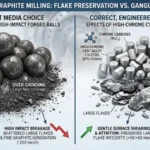
- Selection Logic: Standard carbon steel or low-alloy forged balls undergo rapid surface gouging, resulting in flat-spotting, excessive media consumption (g/ton), and frequent, costly mill charge replenishments.
- Engineered Match: High-Carbide High-Chrome Cast Balls (Cr 12%–18%). Embedded with dense M₇C₃ chromium carbides (microhardness 1,200–1,800 HV), these alloys deliver supreme resistance to silica sand cutting wear.
B. Wet Slurry Chemistry & Metal Oxidation (Corrosive-Abrasive Synergy)
- Operating Condition: Wet grinding slurries containing lime, cement, and quartz operate in a alkaline to mildly alkaline aqueous environment (pH 8.0–11.0). Continuous wet tumbling creates a synergistic wear mechanism where chemical oxidation continuously strips soft metal oxides from the ball surface.
- Selection Logic: Unalloyed steel balls corrode rapidly in wet slurries, generating excessive tramp iron rust (Fe₂O₃) that stains raw slurry and compromises board aesthetics.
- Engineered Match: Passivated High-Chrome Alloy Media (Cr 14%–22%). High chromium content forms a continuous, self-passivating oxide film that effectively suppresses electrochemical wear and prevents slurry discoloration.
C. Strict Fineness Range & Prevention of Over-Grinding (Particle Liberation)
- Operating Condition: Autoclaved calcium silicate boards require an optimal silica fineness (typically passing 200 mesh at 85%–95%) to react efficiently with calcium hydroxide during hydrothermal curing. However, generating excess slimes (ultra-fines) reduces slurry drainability during board forming.
- Selection Logic: Media must provide controlled, surface-contact grinding rather than brutal impact to achieve tight target particle size distribution (PSD).
- Engineered Match: High-Chrome Cylpebs & Small-Diameter Micro Balls (Ø15mm–Ø30mm / Cylpebs). Cylpebs offer line-contact surface area, optimizing fine quartz reduction, improving slurry reactivity, and preventing over-grinding.
2. Media Selection Matrix Tailored to Fiber Cement Raw Material Circuits
| Application Circuit | Fiber Cement Slurry Challenge | Primary Selection Metric | Recommended Media Type | Alloy & Hardness Profile |
|---|---|---|---|---|
| Primary Sand Slurry Mill | Coarse silica sand feed, wet slurry impact | Impact Toughness + Abrasion Resistance | High-Chrome Alloy Cast Balls (Ø40–Ø60mm) | Cr 12%–15% High Chrome Alloy (60–64 HRC) |
| Secondary / Fine Silica Mill | Severe quartz abrasion, wet alkaline environment | Corrosion-Abrasive Wear Resistance | High-Chrome Cast Balls (Ø25–Ø40mm) | Cr 15%–18% High Chrome Alloy (62–65 HRC) |
| Fine Regrind & Slurry Homogenization | Target fineness (passing 200 mesh), preventing slimes | High Surface Contact Area + Low Iron Release | High-Chrome Cylpebs / Micro Balls (Ø15–Ø25mm) | Cr 18%–22% High Chrome Alloy (63–66 HRC) |
3. Measurable Financial & Operational Benefits
- 50%–65% Lower Specific Media Consumption: Replacing standard low-alloy forged balls with engineered high-chrome cast media slashes consumption rates in wet quartz slurry.
- Enhanced Hydrothermal Reactivity: Precise silica particle size distribution optimizes the pozzolanic reaction with lime in autoclaves, improving final board flexural strength (MOR).
- 10%–15% Improved Board Dewatering Speed: Controlled particle size distribution prevents excessive fines, allowing faster drainage on Hatschek forming machines and increasing line speeds.
- Clean Slurry & Zero Staining: Corrosion-resistant chromium alloys eliminate free iron rust contamination, maintaining natural board whiteness and color consistency.
4. Operational Case Study: 15,000,000 m²/Year Fiber Cement Board Plant
Plant Profile: A major fiber cement manufacturer operating wet ball mills to prepare quartz sand slurry (target fineness 90% passing 200 mesh) for autoclaved calcium silicate board production.
The Problem: The plant was using standard carbon steel forged balls. High quartz slurry abrasion combined with wet corrosion resulted in rapid ball wear (820 g/ton of dry sand). Severe flat-spotting reduced grinding efficiency, and iron rust generation caused board surface discoloration.
The Tailored Solution: Transitioned wet sand ball mills to Cr 16% High-Chrome Cast Balls (Ø30mm / Ø40mm dynamic ratio) and introduced Cr 18% High-Chrome Cylpebs (Ø20×22mm) in the fine grinding stage.
The Results:
- Specific grinding media consumption dropped by 59% (from 820 g/ton down to 336 g/ton).
- Sand slurry passing 200 mesh stabilized at 92%, resulting in a 6% increase in board flexural strength (MOR) after autoclaving.
- Eliminated free iron oxide staining, yielding uniform, premium-surface fiber cement boards.
Message us for more information